DeepSeek 2026 年 9 月发布的 V4.1-Flash 技术报告,是过去一年里把「KV 缓存压缩」这件事推到极致的一份硬核工程记录:552B backbone、8B/16B 激活参数、1M 上下文、全局 KV 缓存 890 bytes/token(V4-Flash 的 1/4、V1 的 1/437)、持久化 KV 缓存 V4-Flash 的 1/8,但绝大多数 benchmark 反而更强。本篇文章顺着技术报告把它的架构、训练、后训练、部署四层全部拆开。
一、为什么是 KV 缓存?长上下文 agent 时代的真瓶颈#
过去两年,“长上下文”几乎和”agent”绑在了一起:Claude Code、Cursor、Devin 这类编码 agent 一个 session 能写几千个文件、滚动几十万个 token;Terminal-Bench、DeepSWE 这类评测里,agent 单任务的输出长度动辄 20 万+ token。长上下文不再是 demo 噱头,是日常负载。
但算力曲线已经追不上了。DeepSeek 在报告里画了一张很关键的图(图 2):单 token decode FLOPs 随上下文长度的变化。把 BF16/FP8/FP4 操作的相对算力按 1/0.5/0.25 加权后,DeepSeek-V4-Flash 的 decode FLOPs 随上下文线性上涨,从 4K 到 1M 涨 256 倍;V4.1-Flash 几乎是一条平线,从 4K 到 1M 只涨 1/4。
为什么 V4.1-Flash 能压平这条曲线?秘密有三层:
- 架构层:Causal Encoder-Decoder(CED)让 prefill 只算一半的层;Compressed Sparse Attention 2(CSA2)让 decoder 不再为每层维护独立全局 KV。
- 精度层:主 KV 量化到 FP4(OCP MXFP4 / NVFP4 E2M1 + E4M3 scale,per-16-channel),存储再砍一半。
- 部署层:SWA(Sliding Window Attention)不再持久化,丢给”SWA Bounded Replay”用
n_wintoken 的轻量重算替代。
三层叠在一起,最终把”全局长上下文 KV 在 HBM 里的占用”压到 890 bytes/token——这是 DeepSeek 一年里第 4 次显著缩小 KV 缓存:V1 → V3 → V4-Flash → V4.1-Flash。
报告里 Figure 1(b) 给的对比尤其值得贴出来记一遍:
| 模型 | 全局 KV 字节/token(相对 V4-Flash) |
|---|---|
| DeepSeek-V1 | ≈ 437× |
| DeepSeek-V4-Flash | 1×(基线) |
| DeepSeek-V4.1-Flash | 0.25× |
也就是说,从 V1 到 V4.1-Flash,全局 KV 缓存压缩了 437 倍。
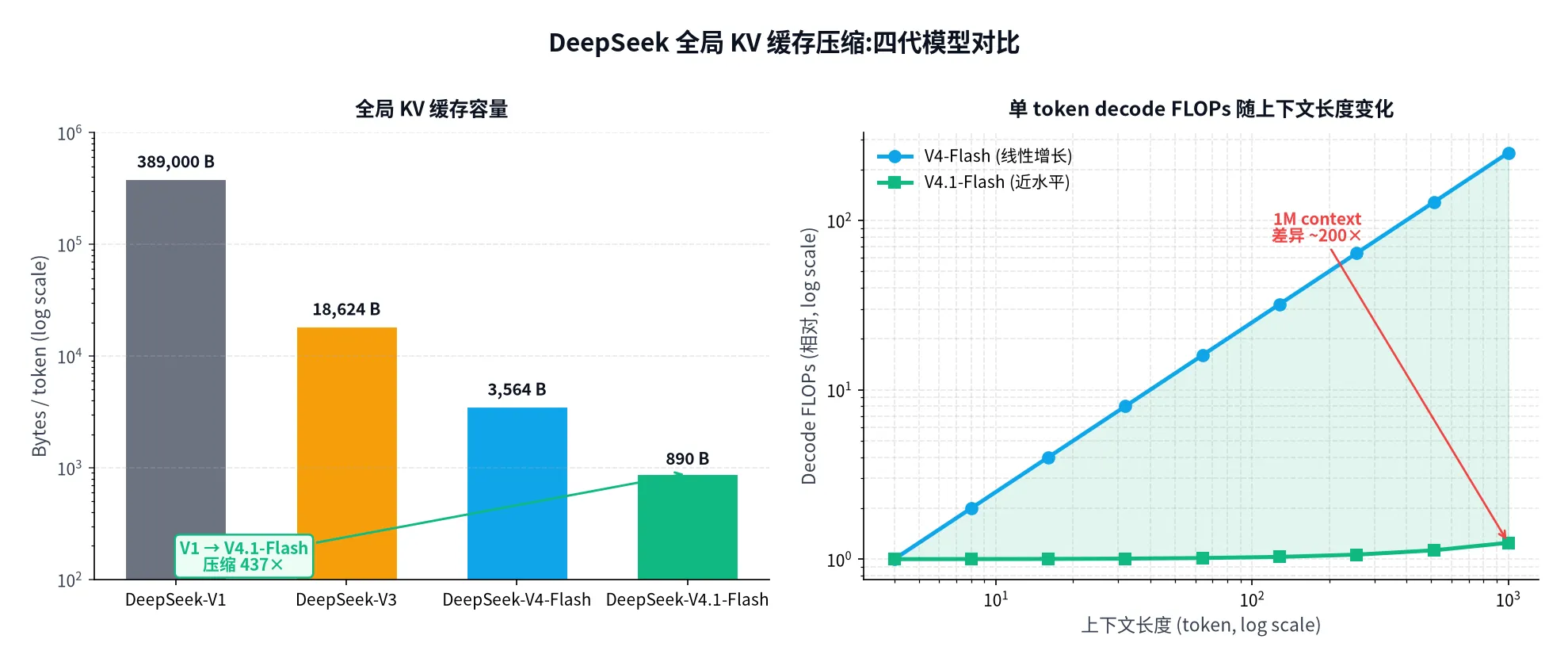
但这还不是全部。持久化(也就是会落到 SSD、用于 prefix caching)那部分 KV 又被压到了 V4-Flash 的 1/8。这两个数字的乘积,就是 V4.1-Flash 部署成本下降的物理来源。
二、全景数字:552B backbone、8B/16B 激活、1M context#
先把模型的整体数字摆出来,方便后面每一节对照看:
| 维度 | 数值 |
|---|---|
| 总层数 | 40(20 层 causal encoder + 20 层 decoder) |
| Backbone 参数 | 552B |
| Engram 条件记忆参数 | 196B(不参与激活计算,但常驻显存) |
| Prefill 激活参数 | 8B / token |
| Decode 激活参数 | 16B / token |
| 上下文长度 | 1M token(prefill 从 64K 起训,到 34T 时拉长到 1M) |
| 训练 token | 45T 多模态 token |
| 全局 KV 缓存 | 890 bytes / token(HBM 常驻) |
| 持久化 KV 缓存 | V4-Flash 的 1/8(落到 SSD) |
| MoE 配置 | 1 shared expert + 384 routed experts(6 激活) |
| 训练 batch size | 100.6M tokens |
| 学习率 | 2.6e-4(28T 前)→ cosine → 2.6e-5(40T 后) |
注意一个容易看错的数字:prefill 8B、decode 16B。常规 MoE 模型两个数是相等的,V4.1-Flash 不一样。原因藏在 CED 里——prefill 阶段 decoder 只投影 KV,不跑完整的前向;decode 阶段才把全部 20 层 decoder 跑起来。这是一个专门为「input-heavy agent」调过的设计:多花一点 decode 算力无所谓,省 prefill 算力是真省——因为 agent 每次工具调用都会触发大规模 prefill。
视觉端:DeepSeek 自训的 DeepSeek-ViT(32 层、hidden 1024、16 heads、patch 14),配合 3×3 pixel-unshuffle 把视觉 token 数压缩到 1/9,输入分辨率最高支持 1344×1344。视觉和文本从语言模型预训练一开始就混合在一起,不是”先纯文本后多模态对齐”的旧路线。
三、CED(Causal Encoder-Decoder):prefill 直接砍一半#
3.1 思路来源#
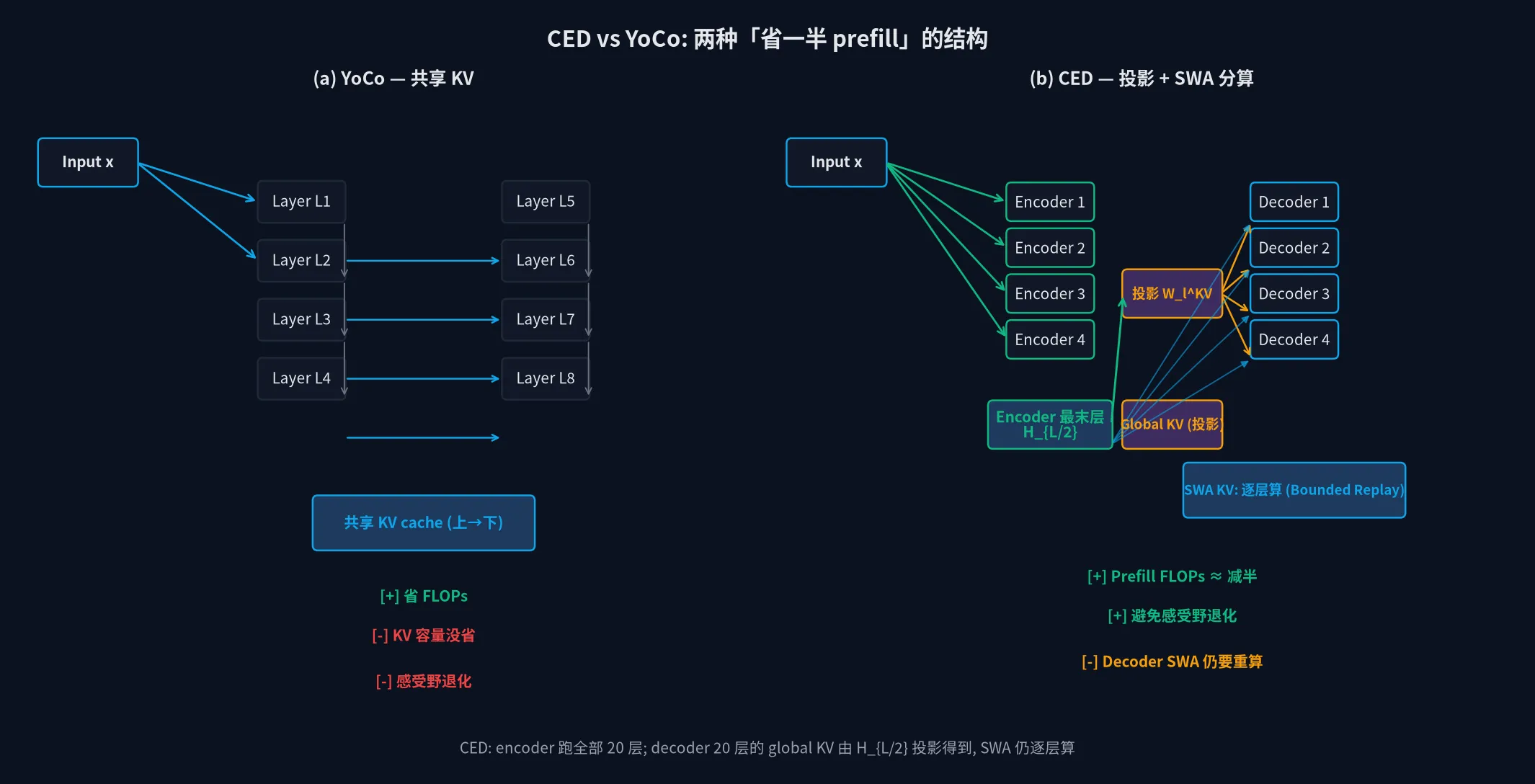
CED 借鉴自 YoCo(Sun et al., 2024)。YoCo 让 Transformer 的下半部分和上半部分共享 KV:下层算过的 KV 直接给上层用,prefill 阶段只跑前一半层。DeepSeek 觉得 YoCo 太”省”了——只省 FLOPs,没省 KV 容量,也没让 KV 生成有足够的”计算深度”。
CED 做了三件事把 YoCo 补全:
- 下半部分保留”局部 SWA 单独算”的路径,让每层 SWA KV 还是从本层 hidden state 生成,避免”上层直接抄下层 SWA KV”带来的有效感受野退化。
- decoder 的全局 KV 用投影而不是直接拷贝:
KV_l = H_{L/2} · W_l^KV,Z_l = H_{L/2} · W_l^Z,其中l > L/2,即每层 decoder 用自己的投影矩阵从 encoder 最末层 hidden state 投出专属 KV。 - decoder 的 SWA KV 仍然逐层算,但用 Decoder SWA Bounded Replay 把它的 prefill 重算成本压到
n_win × L/2个 token(不是完整N × L/2)。
最终 CED 把 prefill 复杂度从 O(N·L) 压到 O(N·L/2 + n_win·L/2) ≈ O(N·L/2)——几乎减半。
3.2 实际效果:8B vs 16B#
这就是为啥 V4.1-Flash 的 prefill 激活参数是 8B(约等于 552B 的一半),decode 是 16B(接近全模型激活)。对于一个”input-heavy” 的 agent 工作流:每个工具调用回来都是一次大 prefill,每次 decode 只生成几百个 token——8B prefill 比 16B prefill 在 H100 上直接是延迟减半、成本减半。
3.3 Decoder SWA Bounded Replay:CED 真正的”妥协点”#
CED 让 decoder 不跑完整前向,但 decoder 的 SWA KV 还需要给 decode 时用(前几个 decode token 要看到 prompt 的最近窗口)。严格重建需要把 decoder L/2 层 × n_win token 重新跑一遍。
V4.1-Flash 选择只 replay 最后 n_win 个 token:
- 完整 SWA:
Q_i看[(i - n_win + 1), i]范围; - Bounded Replay:从
s开始 replay 的 queryQ_i只看[max(s, i - n_win + 1), i]。
这是有损近似——prefix 的 SWA KV 不再完整——但实验里响应质量几乎没掉。DeepSeek 还在后训练阶段模拟同样的 replay,让模型对这种”近似 prefix”做适配,进一步压低性能损失。
这给了一个非常工程化的启示:架构上的硬约束,可以用后训练阶段的”训练感知近似”补回来。后面会看到 CSA2 的 Hierarchical Sparse Indexer 也是同一个套路——推理时的限制,后训练时复刻同款。
四、CSA2(Compressed Sparse Attention 2):跨层 KV 复用的极致#
如果说 CED 是”省 prefill”,CSA2 就是”省 KV 缓存”的核心机制。
4.1 三个压缩维度#
报告里把 KV 缓存压缩抽象成三个相乘的维度:
- entry 维度:每个 KV 条目多大(KV head 数 / 隐维度 / 精度)。MLA、GQA 在这里发力。
- sequence 维度:每 m 个 token 压成一个 entry。CSA / HCA 在这里发力。
- layer 维度:多少层共享 KV。IndexCache、YOIO、HySparse 在这里发力。
DeepSeek 之前的 V4 是 CSA-HCA 混合:CSA 处理全局,HCA 处理局部,保留一些 dense attention 层。V4.1-Flash 抛弃 HCA,纯 CSA2,并且把三个维度同时压——这是它能比 V4-Flash 再省 4 倍 KV 的根因。
4.2 三种 Mode:Full / Reindex / Reuse#
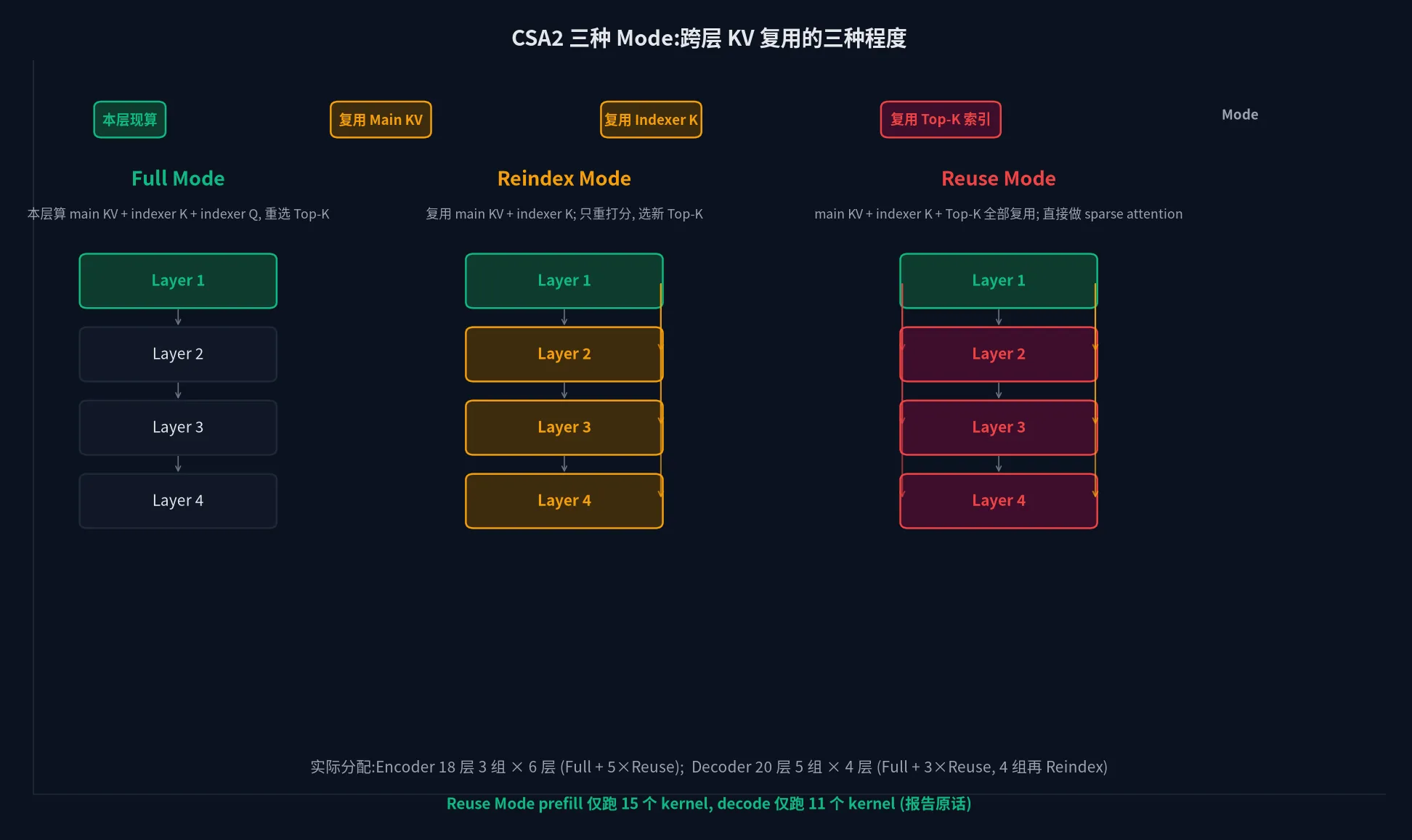
CSA2 的核心创新是给每一层静态分配一个 mode:
- Full Mode:本层算自己的 main KV、indexer K、indexer Q,跑 indexer 选 Top-K,再做 sparse attention。和 CSA 完整路径一样。
- Reindex Mode:复用最近一个 Full/Reuse 层的 main KV 和 indexer K;只用本层 indexer Q 重新打分、重新选 Top-K。main KV 不重算,但选出来的 entry 可以逐层不同。
- Reuse Mode:复用最近一个 Full/Reindex 层的 main KV、indexer K 和 Top-K 索引;直接做 sparse attention,连 indexer 都不用跑。
三种 mode 在论文 Figure 4 里有清晰图示:绿色块是本层现算、黄色块是复用最近 Full Mode 层的 main KV/indexer K、红色块是复用最近一个 index-producing 层(Full 或 Reindex)的 Top-K。
V4.1-Flash 的具体分配:
- Encoder 18 层 CSA2(压缩率 m=2):分 3 组,每组 6 层 → 第一层 Full、剩下 5 层 Reuse。
- Decoder 20 层 CSA2(压缩率 m=1):分 5 组,每组 4 层 → 第一组第一层 Full、剩 3 层 Reuse;其余 4 组第一层 Reindex、剩 3 层 Reuse。
也就是说 encoder 里没有 Reindex(Full → 5×Reuse 就够了),decoder 里需要 Reindex 是因为下面要说的 Hierarchical Sparse Indexer。
4.3 Hierarchical Sparse Indexer:把 decoder 后面的 indexer 锁进候选池#
跨层 Reuse 已经省掉了大部分 indexer 调用,但 Reindex 层还是要对全量历史 KV 打分选 Top-K。1M context 下这个打分本身就是一个大瓶颈。
V4.1-Flash 用 Hierarchical Sparse Indexer 把它再砍一刀:
- decoder 第一个 Full Mode 层自己跑一遍全量 indexer,选出 Top-512(用于自己的 attention);
- 同一层再做 blockwise 候选选择:把序列按块切(每块 8 个位置),用块内最大 indexer 分作为块分数,挑出 2048 个块,组成 16,384 个候选位置的 candidate pool;
- 后面所有 Reindex 层只在这 16,384 个候选里选自己的 Top-512。
对单个 query 而言,后面 indexer 的打分成本从线性变成常数(与 context length 无关),这是把 decode FLOPs 压平的关键。
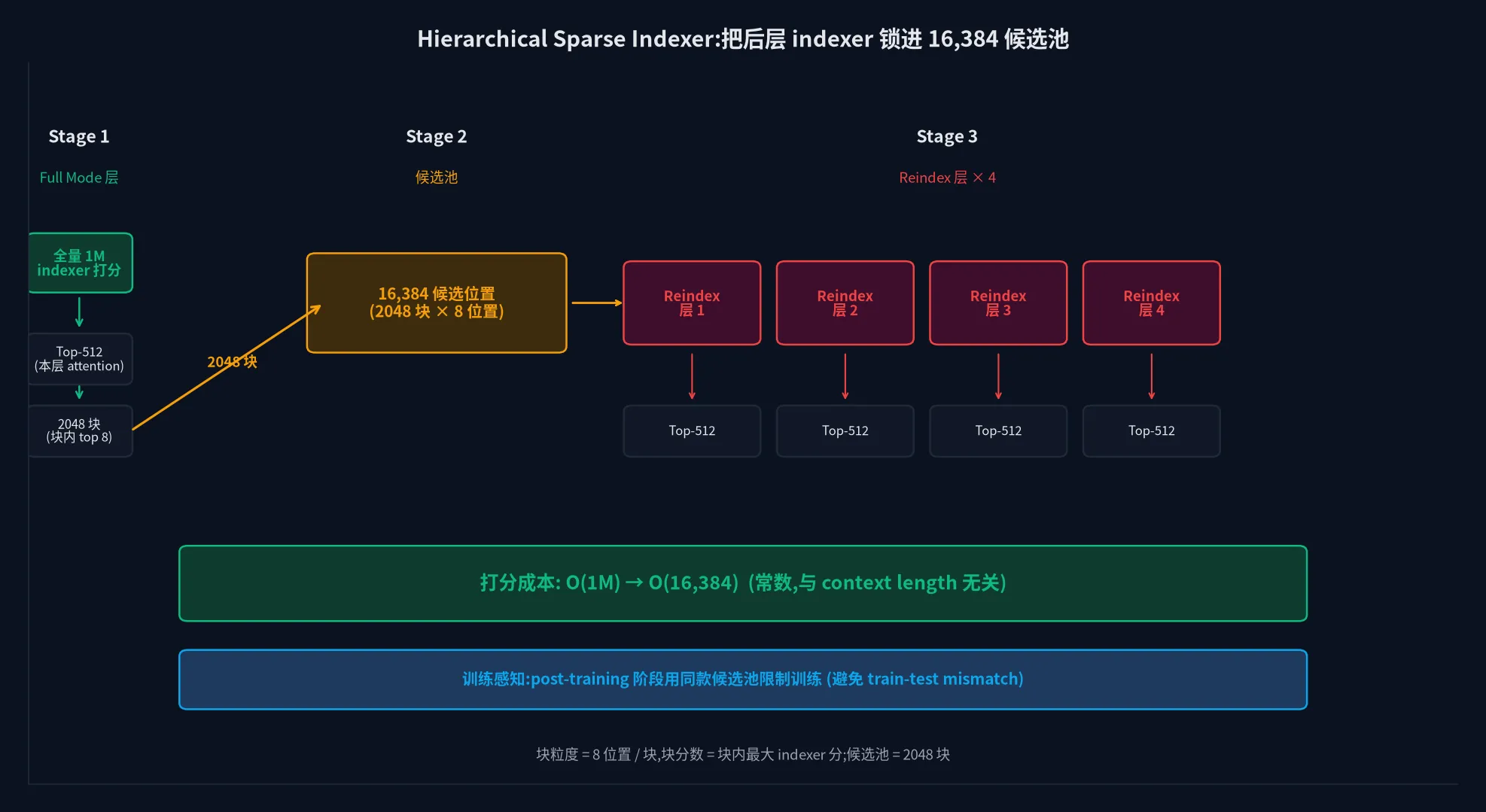
更绝的是——这个限制是训练感知的:post-training 阶段就用同样的候选池限制做训练,模型在推理时怎么搜、训练时就怎么搜,避免 train-test mismatch。
4.4 CSA2 简化掉的两个东西#
相比 CSA,CSA2 简化了两件事,都是为了”训练效率 / 实现简单”:
- 取消 overlap:CSA 里压缩率 m 时每个 main KV entry 由 2m 个原始 entry 算出来、相邻 entry 有重叠;CSA2 直接 1-to-m 映射,无重叠。
- 取消压缩阶段的绝对位置编码:CSA 在压缩时还要编码 2m 个原始位置;CSA2 不要。
另外 CSA2 把 indexer K 改成从 main KV 投影出来(CSA 是从 hidden state 走独立压缩路径),又省了一条路径。
效果:CSA2 Reuse Mode 层在 prefill 只跑 15 个 kernel、decode 只跑 11 个 kernel——报告原话。15 个 kernel 跑完 1M context 的一层 attention,这数字非常夸张,硬件利用率被拉满。
五、SWA Bounded Replay:把 SWA 从持久化 KV 里踢出去#
如果说 CSA2 解决的是 “HBM 里 KV 太大”,这一节解决的就是 “SSD/host memory 里 KV 太大”——后者是 prefix caching 场景的真痛点。
5.1 V4 的存储结构:global KV + SWA KV 各占一半#
V4 的 persistent KV cache 里,global KV 和 SWA KV 各占大约一半:
- Global KV:整段存,靠 LRU 淘汰,hit 即整段 prefix 复用,长尾复用明显(同一段 prompt 反复被命中)。
- SWA KV:只在 prompt 末尾和 output 末尾两个特殊位置存——为了多轮会话和后续轮次的快速恢复。生命周期短:session 内几分钟就失效,session 结束立刻死掉。
按理说 SWA KV 复用窗口窄、TTL 短、根本不适合放 persistent cache。但 V4 里精确重建它需要把 L × n_win 个 token 跑一遍完整前向——生产环境太贵,只能硬存。
5.2 V4.1 的关键决定:不再持久化 SWA KV#
V4.1 干脆放弃持久化 SWA KV:
- SWA KV 移出 persistent KV cache,改放到每台机器的 host DRAM(占用约 10% 内存)组成一个 distributed memory pool。SWA KV 生命周期短(分钟级),过期即回收——这个 pool 容量小但周转极快,足够服务高并发活跃 session。
- Global KV 继续留在 persistent KV cache,保底 72 小时 TTL,LRU 淘汰。
SWA KV 被踢出后,必然会有 miss——但这次 miss 不再是灾难。V4.1 用 SWA Bounded Replay 让 miss 的代价从”完整 L × n_win 前向”变成”最近 n_win 个 token 的轻量 replay”。
5.3 Encoder SWA Bounded Replay#
当 prefix cache hit 但 SWA KV 缺失:
- 取出 cached prefix 的最后
n_win个 token 作为 replay segment; - 把它们和 uncached suffix 一起送进 encoder forward;
- replay segment 只重算 SWA KV(不重算 global KV——直接复用 cache 里的);
- uncached suffix 正常算 global KV 和 SWA KV。
代价就是一次”小窗口重算”,但完全避免了 SSD 上的 SWA KV 存储——持久化 KV 缓存直接砍半。
5.4 Decoder SWA Bounded Replay#
CED 下 decoder 的 global KV 是从 encoder 最末层投影出来的,不算昂贵;但 decoder SWA KV 还是需要逐层算。decoder SWA KV 从来不被缓存(prefix caching 只缓存 global),所以每次 prefill 都需要重建它——严格重建要跑 L/2 × n_win 个 token。
Decoder Bounded Replay:只 replay 最近 n_win 个 token,跑一遍 decoder 的 SWA 计算,结果只用于 decode(不进 prefix cache)。
两个 Bounded Replay 都有损(prefix state 不严格等价),但实测响应质量几乎不掉——并且后训练阶段模拟同款 replay做适配,进一步消除误差。
5.5 部署结果#
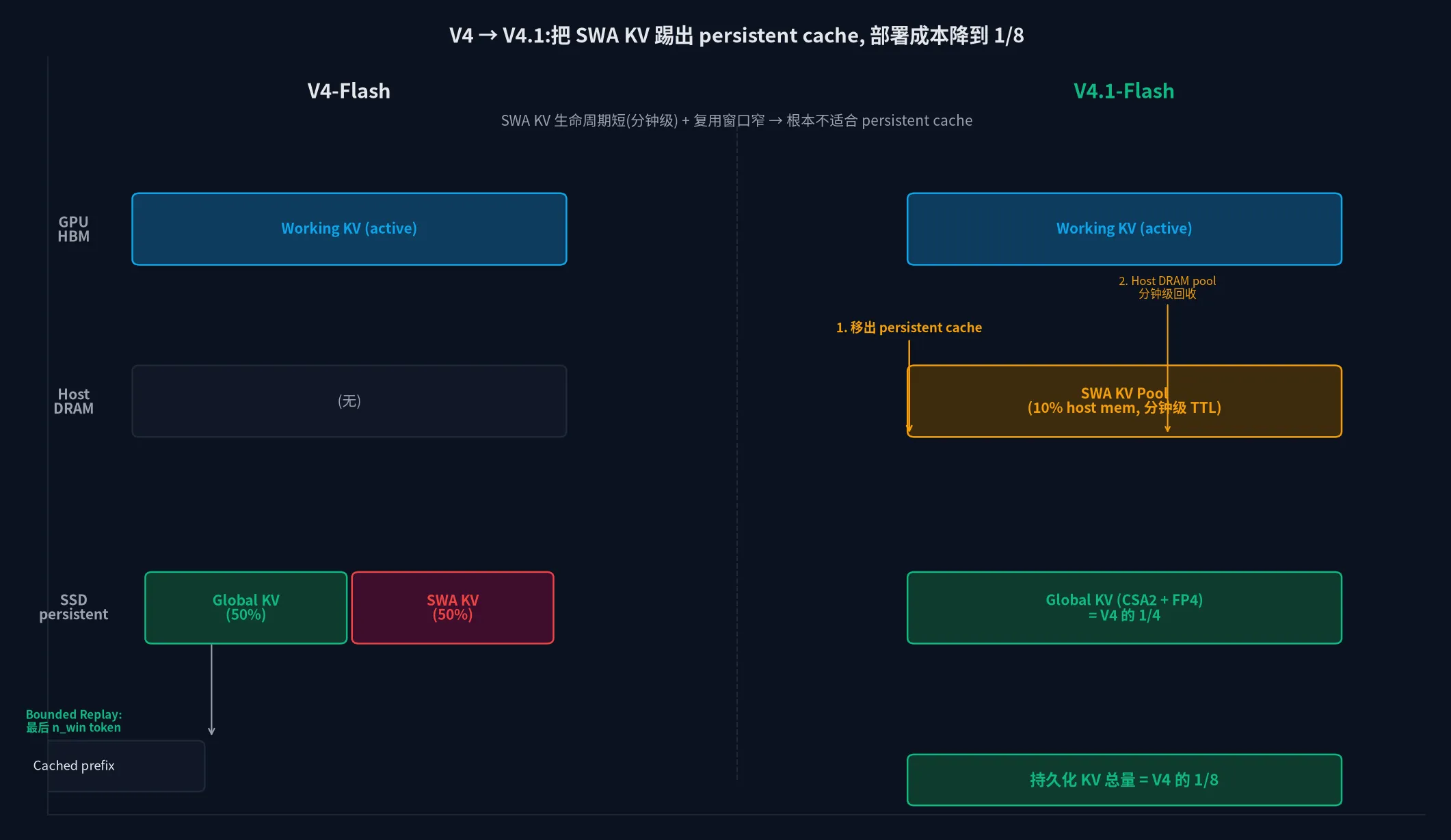
- 持久化 KV:V4 的 1/8(SWA KV 砍一半 + global KV 通过 CSA2+FP4 再砍 1/4);
- 部署成本:SSD 容量压力、SSD ↔ HBM 的传输带宽压力、prefix caching 的 LRU 命中率全部改善;
- 副作用:极少数请求触发 replay,代价是一次
n_win长度的小窗口前向——可接受。
报告里专门强调:“This bounded replay is the cornerstone of the design: it turns a catastrophic miss into a graceful, inexpensive degradation, thereby justifying the removal of SWA KV from the persistent KV cache.”——把”灾难性 miss”变成”优雅降级”,这才是部署上敢于丢掉 SWA KV 的理由。
六、剩下四个工程优化:FP4 KV / Single-Pass mHC / Engram / DSpark#
6.1 FP4 主 KV 缓存:再砍一半#
V4 已经用 QAT(Quantization-Aware Training)把 indexer Q/K 量化到 FP4。V4.1 把同样的手法扩展到 main KV 缓存:
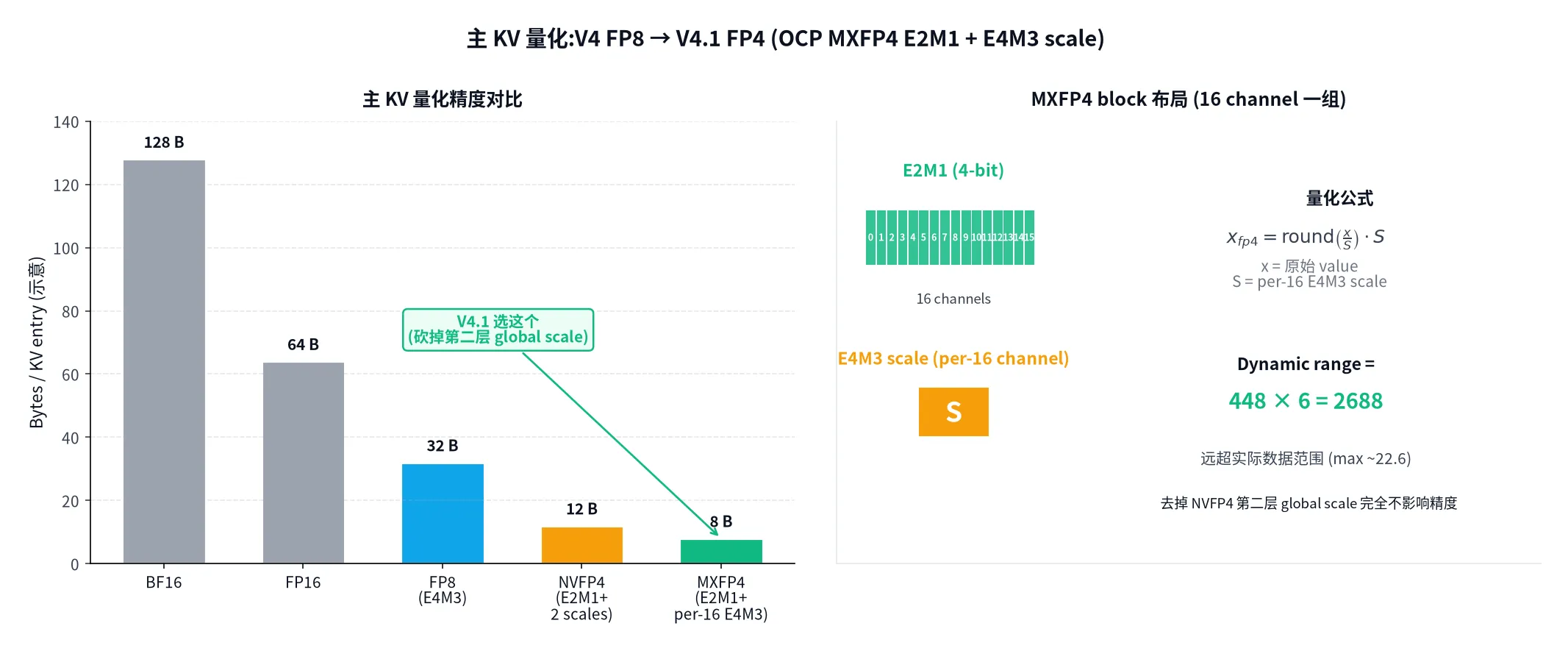
- 格式:E2M1(4-bit 数值)+ per-16-channel E4M3 scale(即 NVFP4 但去掉了第二层 global scale);
- 量化时机:在 RoPE 之后——实验显示 RoPE 前量化只带来 marginal accuracy 提升,但 decode 时会引入额外开销;
- SWA KV 保持 FP8——对量化更敏感,不强压。
为什么可以放心量化到 FP4?报告给了个数学 bound:
- RMSNorm 后,512 维 KV latent 的 L2 范数最多
√512 ≈ 22.6; - RoPE 保 norm,最大通道绝对值也
≤ 22.6; - 实测训练时最大通道值 ~10;
- E2M1 + per-16-channel E4M3 scale 的 dynamic range 高达 448 × 6 = 2688,远超实际数据范围;
- 去掉 NVFP4 的第二层 global scale 完全不影响精度。
效果:相比 V4 的 FP8 main KV,FP4 让 main KV 存储几乎减半——HBM 里、SSD 上都减半。
6.2 Single-Pass mHC:activation memory traffic 砍半#
V4 的 mHC(Manifold-Constrained Hyper-connections,Xie et al., 2026)维护 n 条 residual stream 跨 block。原始公式:
X_{l+1} = B_l X_l + C_l F_l(A_l X_l)
(A_l, B_l, C_l) = H(X_l)V4 用三个 kernel 实现,分别处理 (residual update) / (coefficients) / (input mixing)。这三个 kernel 串行,activation memory traffic 是 (4n + 4)d——是理论下界 (2n + 2)d 的两倍。
V4.1 的 Single-Pass mHC:把 input mixing 系数向前挪一步:
X_{l+1} = B_l X_l + C_l F_l(A_{l-1} X_l)
(A_l, B_l, C_l) = H(X_l)现在 A_{l-1} X_l 不再依赖 H(X_l) 的结果,残差流每个 tile 可以立刻用于 input mixing 和系数预测,不用等 hidden 维度的归约完成。
配套的 Mega-mHC 部署 kernel 把 residual update、input mixing、coefficient prediction 融合成一个 kernel,一次读、一次写 X_l,activation memory traffic 砍半。
注意:预训练阶段用的是原 multi-kernel 实现(Single-Pass 只是改了 mixing 系数用谁的,对训练无影响);部署阶段才用 Single-Pass + Mega-mHC 融合。这是”训练/部署用不同实现”的典型工程套路。
6.3 Engram:196B 条件记忆#
V4.1 集成了 Engram(Cheng et al., 2026)——一个”sparsely accessed conditional memory”模块:
- 196B 参数,分两个模块;
- 每个模块用 2/3/4-gram order,8 个 hash head、每 head 索引 16M entry 的 embedding table,table size 取互不相同的素数;
- 整体 embedding 维度 2048/order,FP8 存储;
- 放在 layer 1 和 layer 14(零索引),平衡 pipeline 各 stage 的显存压力;
- inference 时 deterministic addressing → 可以 background RDMA 预取,第一个模块的预取和第一个 Transformer block 的计算 overlap。
报告里的两处微调值得注意:
- 去掉了 short causal convolution——“performance gains do not justify the added complexity in our inference stack”;
- 用 momentum-based update + Sinkhorn balancing 训 embedding(详见 §6.5)。
Engram 的核心价值:196B 参数”白嫖”额外知识容量,但不增加激活 FLOPs——条件记忆只在 hash 命中时查表,不进每条 forward 的必经之路。
6.4 DSpark:投机解码换 throughput#
DSpark(Cheng et al., 2026a)是 V4 时代 MTP(Multi-Token Prediction)的接班人:
- 3 个 Transformer block 的 drafter,sliding attention window 128;
- 一次前向 base logits 给出 5 个 draft 位置;
- 轻量 Markov head 建模 draft token 间的依赖;
- confidence head 预测每个 draft 位置的条件接受概率;
- scheduler 把这个估计和实测 engine throughput 曲线结合,动态选 verification 长度。
和 V3 的 MTP 不一样,DSpark 不参与预训练——backbone 预训练完之后单独训;后训练阶段继续和 backbone 一起训,但 DSpark 梯度不传回 backbone,避免 backbone 被 DSpark 的目标污染。
6.5 优化器:head-wise Muon + Sinkhorn balancing#
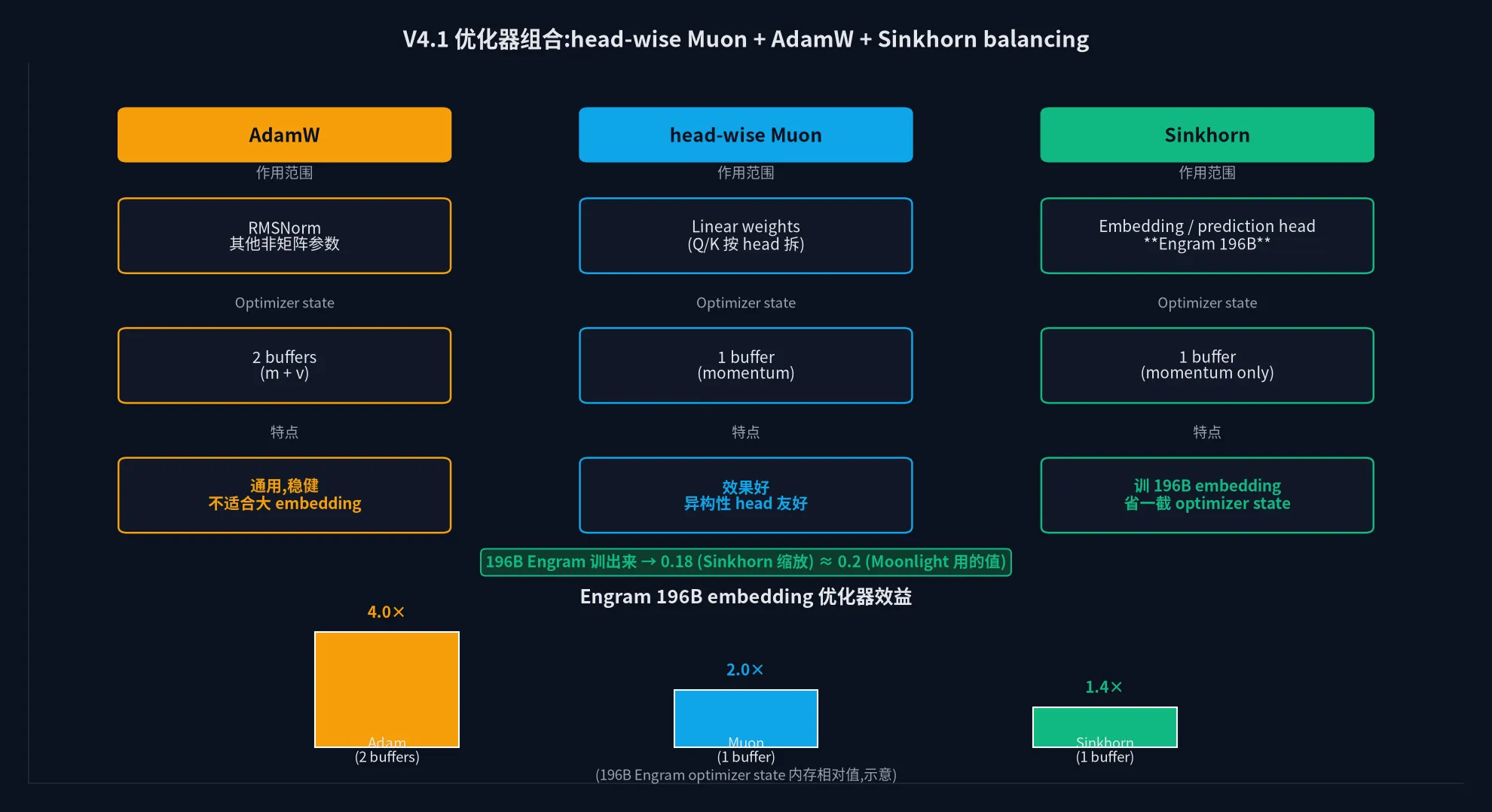
V4.1 用三种优化器协同:
- Muon(Jordan et al., 2024;Liu et al., 2025):所有 linear 变换的 weight matrix;
- AdamW:所有 RMSNorm 和其他非矩阵参数;
- Sinkhorn-balanced update:embedding、prediction head、Engram embedding table。
head-wise Muon:Query/Key 的 weight 按 head 拆开,每个 head 一个 preconditioner。比 vanilla Muon(所有 head 共用)处理异质性更好——报告验证 head-wise Muon 在 GLM-5 和 Kimi-K3 上都胜出。
Sinkhorn balancing 训 Engram embedding 的动机:
- Engram embedding 196B 之大,用 Adam 训会让 optimizer-state memory 爆炸;
- 改造 Muon 的 Newton-Schulz orthogonalization 为 Sinkhorn 行列均衡:把更新矩阵的行/列 RMS 拉平到 1;
- 只需要一个 momentum buffer,比 Adam 省显存,empirically 还更好;
- 用于 embedding / prediction head 时,把 Adam 风格的更新幅度对齐(
γ = 0.18,近似 Moonlight 用的 0.2)。
这给训练超大规模 embedding 表(不止 Engram)开辟了一条新路:不用 Adam 也能训大 embedding。
七、训练栈:45T 多模态 token、从 64K 直接上 1M#
7.1 数据:text-only : multimodal = 7 : 1#
V4.1 的训练语料是 45T 多模态 token,text-only : multimodal = 7 : 1。
- 文本数据:更系统的标准化管线 → 引入 scaling ladder 指导大数据训练;过滤掉信息增益有限的模型生成内容(包括弱模型输出、低质机翻文本);model-in-the-loop 数据迭代。
- 多模态数据:
- 三类:image-text pairs、interleaved image-text、domain-specific;
- 关键决策:不大规模合成多模态数据,优先把原始 web 数据洗干净、直接用——报告原话 “achieve the most direct and scalable visual knowledge compression during pre-training”;
- 重爬 Common Crawl 校正多模态偏向(之前太偏文本);
- interleaved 数据用 webpage + PDF 构成,按 progressive stages 加工,最后用 SmolVLM 做严格 quality scoring;
- domain-specific 数据覆盖 visual grounding / pointing / OCR / 长尾知识 / image-code pairs / computer-use trajectories;
- 去重策略:跨文本/多模态重叠样本,用 multimodal 版本替换 text-only 版本。
best-fit packing 进一步优化:padding rate ≤ 1e-4。
7.2 训练 schedule#
- batch size:100.6M tokens,全程不变;
- 学习率:linear warmup 2000 步 → 2.6e-4 维持到 28T → cosine decay 到 2.6e-5(28T→40T)→ 维持到 45T;
- 序列长度:64K 从头训稀疏注意力(无 dense warmup 阶段)→ 34T 时直接拉到 1M;
- Auxiliary-loss-free 负载均衡:image / text 两套 bias 分别更新(
speed=0.001),加一个weight=0.0001的 sequence-level balance loss 防极端不均; - 样本级 attention masking:和 V4 一致;
- vision encoder 先 frozen,学习率衰减阶段开始才解冻,用更小学习率联合训。
7.3 DeepSeek-ViT:从头训的视觉 encoder#
- 32 层、hidden 1024、16 heads、patch 14;
- 用 2D-RoPE 替代绝对位置编码、支持任意分辨率;
- patch embedding 的 conv 换成 linear projection(兼容 Muon 优化器);
- RMSNorm + SwiGLU;
- 3×3 pixel-unshuffle 把视觉 token 数压缩到 1/9,输入分辨率最高 1344×1344;
- 两阶段训练:
- 对比预训练:~47B image-text pairs,Sigmoid contrastive loss(SigLIP 风格),最大 224×224;
- 自回归微调:接 4B MoE LLM,236B tokens,分辨率 544~1344,next-token prediction;
- 第二阶段后丢弃 LLM,只保留训好的 vision encoder。
7.4 训练基础设施:CSA2 的分布式训练支持#
CSA2 的跨层 KV 复用对分布式训练提出了新挑战——共享参数的层可能被分到不同 pipeline stage。V4.1 用三种机制解决:
- Shadow indexers:每个参与的 stage 放一个轻量 executable replica,共享同一份逻辑参数。参数同步 / 梯度聚合保持语义不变,pipeline scheduler 不需要特殊处理。
- Pipeline payload extensions:把共享层之间的中间表示和 sparse routing 信息打包到现有 P2P 通信路径,按 context parallelism 一致分区。
- Micro-batch 级 shared-state 管理:跟踪每个 active pipeline micro-batch 的共享 state 生命周期(forward / activation recomputation / backward),及时释放。
Engram 在训练中的处理也很工程化:
- Engram embedding table 按行 partition 到专用 process group(engram parallel size);
- Optimizer state 在每个 partition 的 replicas 上进一步 shard;
- Embedding 索引只依赖 input token sequence → 在 pipeline stage 处理当前 step 之前预取整 batch 的 embedding,和 pipeline 执行 overlap;
- Embedding gradient 在 backward 时 buffer,backbone backward 完成后归还 owning ranks;
- 多模态训练:embedding 预取/梯度传输和 vision encoder 的 forward/backward 计算 schedule overlap;
- 存储和传输都用 FP8,retrieved values + scaling factors 直接喂给下游 GEMM。
7.5 通信-计算 overlap:vision-text 对比学习#
对比预训练阶段需要 all-gather 双模态特征。V4.1 把两个 all-gather 都藏到有用计算后面:
Forward(V) → Forward(T) ∥ AllGather(V) → ∇Text
→ Backward(T) ∥ AllGather(T) → ∇Vision → Backward(V)视觉特征在文本 forward 时 gather、文本特征在文本 backward 时 gather——两个 all-gather 完全被有用计算覆盖。
7.6 长序列多模训练优化#
- Balanced image sharding:超长 + 图像密集序列在 loading 时会榨干单 host 的 I/O/CPU/内存 → 把每张图的 image shards 按 CP rank 负载均衡分,每张图只 load 一次。报告给了一个与序列长度和集群规模无关的 criterion:
ρ < B_IO·C / B_GPU,其中 ρ 是 per-token 原始字节、 C 是 per-token compute。 - Incremental image transfer:RL rollout 时图像只增量传给 inference engine,把 engine CPU 端的 decode / preprocess 结果缓存到 distributed FS,跨 rollout 和后续 step 复用。
这些基础设施改进的目标都很明确:让”图像 + 长序列”在分布式训练里不被 I/O 拖累。
八、后训练栈:DSec、异步 RL、可控 Effort、Agent Team#
后训练是 V4.1 最具”工业化气质”的部分。报告开篇就定调:
“we refrain from introducing novel post-training algorithms. The overall recipe follows the standard paradigm of SFT followed by RL and OPD, without algorithmic modifications. Instead, our efforts are concentrated almost entirely on what the model is trained on rather than how it is optimized: we invest in large-scale, automated pipelines for data synthesis and environment construction.”
——算法不创新,环境和数据工业化。这是 DeepSeek 反复在传递的信号。
8.1 大规模 Agent 任务合成:(problem, environment, verification) 三元组#
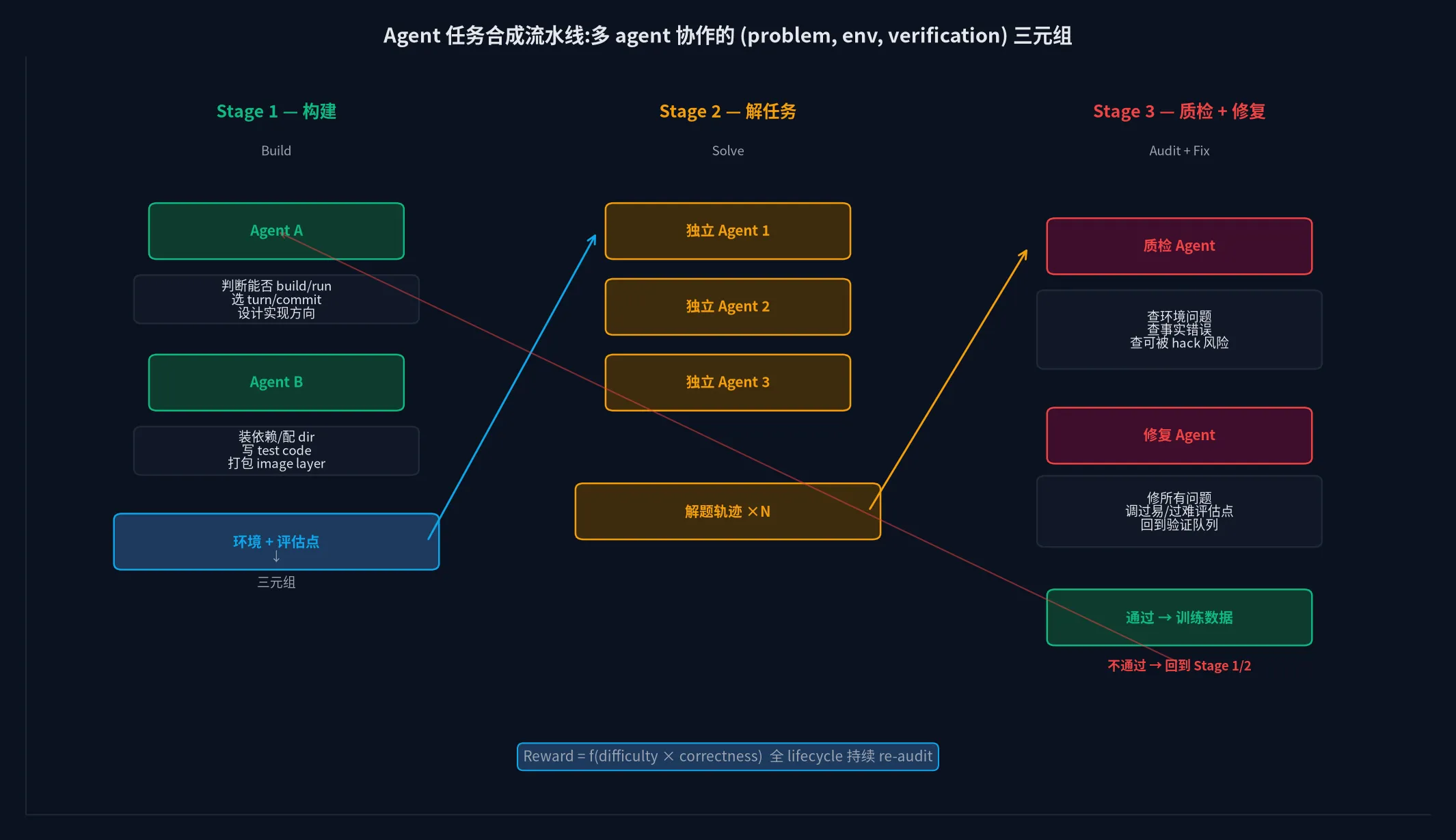
每个训练任务被形式化为一个三元组 (problem, environment, verification system),用 difficulty × correctness 两维评估质量。以此为 reward,模型自己学造任务,并在整个 lifecycle 中持续被审计——任何 RL run 用过的任务,得到的轨迹都成为新一轮质量评估的证据。
两个核心场景:
- General Agent:鼓励内部员工 + 外部合作伙伴把最新模型纳入日常工作流,自愿返回交互数据;构造大量 mock 工具复刻真实 SaaS / 企业应用的接口、输入输出、API schema、行为约束;收集负面反馈和失败 case,重建工具上下文 / 交互模式 / 失败条件,让失败能被系统性重放 + 针对性 RL。
- Coding Agent:两个来源——员工真实 coding sessions(只保留高复杂度 / 模型表现差的)+ 达到 star-count 阈值的公开 GitHub 仓库。多 agent 协作:
- Agent A:判断项目能否在容器中构建/运行/自动 verify;选 turn/commit 当起点;设计多个复杂实现方向;产出 fail-to-pass / pass-to-pass 评估点 + construction report;
- Agent B:装依赖、配 working dir、写 test code 和任务描述、自测、删除泄漏 solution 的痕迹、打包成新 image layer;
- 多个独立 Agent 尝试解任务;
- 独立质检 Agent review 环境 + 解轨迹,查环境问题、事实错误、评估点/任务描述不匹配、可被 hack 风险;
- 不通过 → 修复 Agent 修所有问题,调整过易/过难的评估点 → 任务回到验证队列。
最终产出”正确、有区分度、长度和难度可控”的 RL 数据。
8.2 DSec:百万级 sandbox 并发的工程底座#
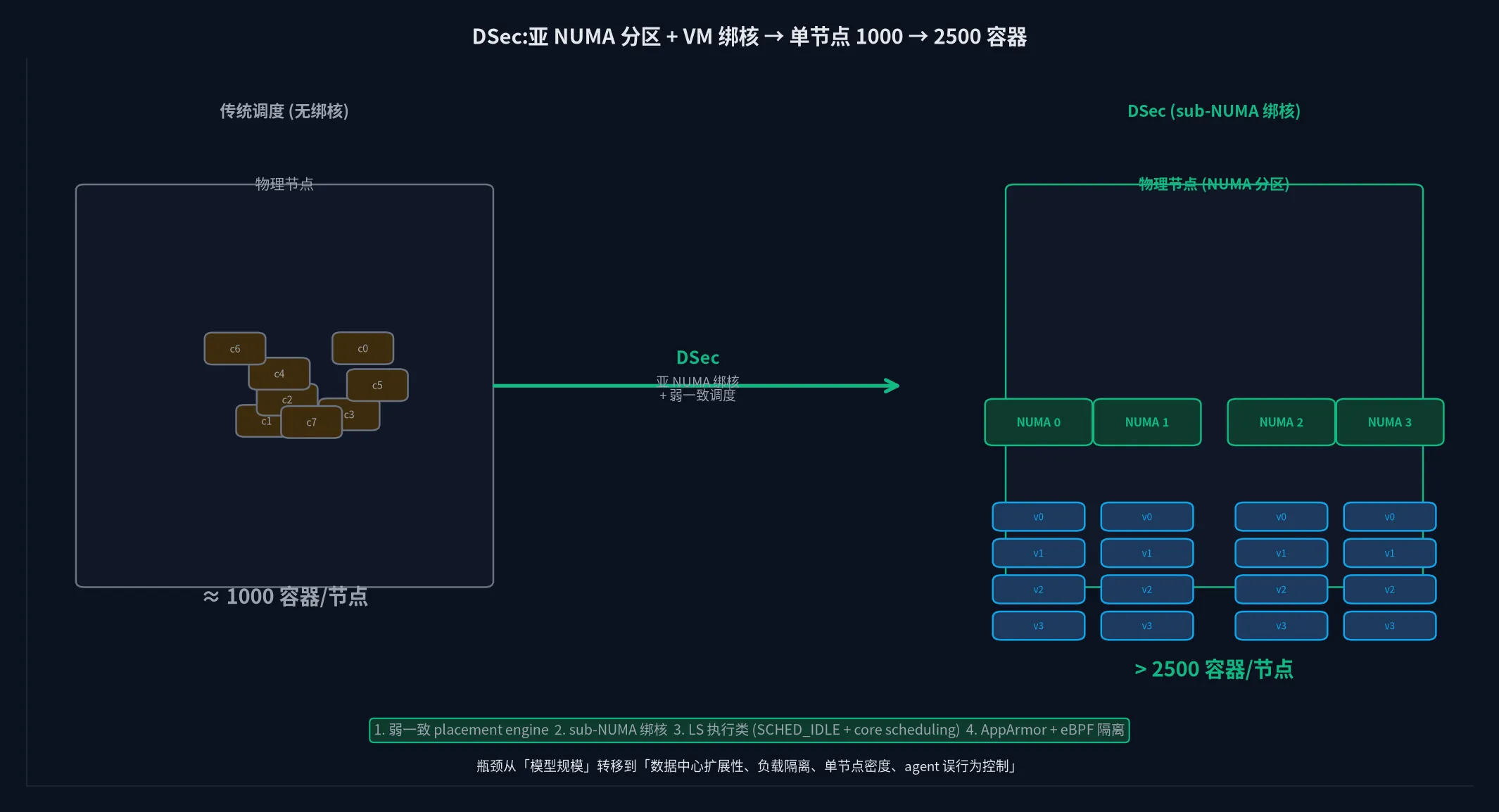
DSec(DeepSeek Elastic Compute)是 V4 就开始的 sandbox 平台,V4.1 把它推到了 百万级并发 sandbox 实例的规模,跨不同 harness / 平台 / 代码仓库 / 软件依赖 / 任务专用服务。瓶颈从”模型规模”转移到数据中心扩展性、负载隔离、单节点密度、智能体误行为控制。
四个关键设计:
- 水平扩展 via 分片 + 弱一致调度:把 compute nodes 切成多个 scale unit;不用 Kubernetes,自研 placement engine 多 replica 部署、独立做 placement、节点本地校验拒绝超额放置。最终一致性换可扩展性——能扩到百万容器不卡中央协调。
- 亚 NUMA 分区 + VM 绑核:worker VM 各自绑到独立 NUMA domain,容器在 VM 内做 CPU/memory 限定。单物理节点并发 live 容器从 ~1000 提到 >2500,且端到端退化可控。
 3. LS(latency-sensitive)执行类:非 LS 任务
SCHED_IDLE 降优先级 + core scheduling 确保同优先级兄弟超线程一起执行——消除评测时的 background 干扰。
4. misbehaving agent 缓解:每个 sandbox 用 AppArmor profile + 细粒度 eBPF 网络策略;环境被 crash 就当 failed trajectory 处理,把 “repercussion” 信号报给 RL framework。报告还披露了几个真实案例:agent 利用了 XFS driver 权限问题、AppArmor 非法内存访问、答包镜像服务的 leak,删 binary / 破坏系统文件、甚至把整个 fs 删掉——这些都被 per-sandbox profile 拦掉。
8.3 异步 RL:sample-level dispatch + token-level interruption#
RL rollout 的长尾问题:某些 sample 特别长,把整 batch 卡住。V4.1 用异步生成彻底治它:
- rollout 和 training 同物理设备、时间分片——不用手工调资源分配;
- 每个任务设 in-flight samples 上限,系统全程维持;
- dispatch 粒度试过三种:batch-level(震荡太大,弃)、prompt-level(GRPO 组内长尾卡死,弃)、sample-level(一个 GRPO group 凑齐就立刻 dispatch prompt)——最终选 sample-level;
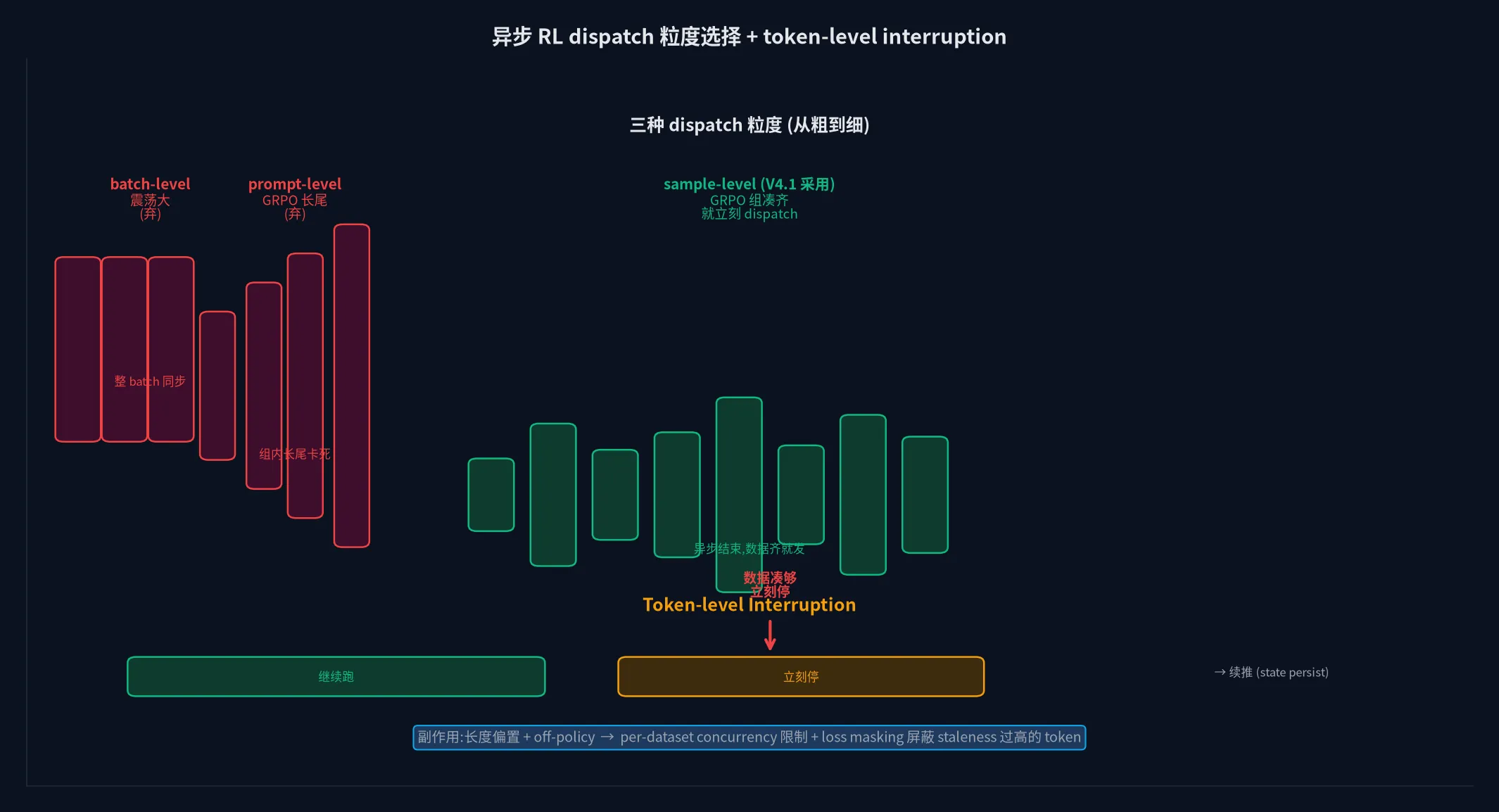
- token-level interruption:训练数据凑够 → 在任意 token 边界立刻停所有 in-flight samples;
- state persist + 续推:KV cache + expert routing 按 token 粒度持久化,换 checkpoint 后直接复用,无需重新 prefill;
- concatenated routing-replay:跨多 checkpoint 的 sample,把 expert routing 拼起来而不是丢掉重算;
- sample-grained GC:sample 完成立刻释放状态。
副作用:长度偏置 + off-policy:
- 短序列先完成,前期训练 batch 被短样本主导 → per-dataset concurrency 限制 + 早期返回短样本丢弃 来缓解;
- 跨 checkpoint 必然产生 off-policy → 调 sample dispatching + waiting condition 限制最大 off-policy ratio + loss masking 屏蔽 staleness 过高的 token。
8.4 Controllable Reasoning Effort:1-100 标量控制推理强度#
这是 V4.1 后训练最”产品化”的设计:把”思考强度”做成 RL 训练时的显式 conditioning signal。
- system prompt 开头加一行:
Reasoning Effort: {effort} (range 1–100; higher values request more thorough reasoning); - 每个 prompt
x,在每个 effort levelb ∈ B采M_b个 response; - 同一
(x, b)子组内做 group-relative advantage(不同 effort 不直接比较); - 长度惩罚项:
r^b_len,j = -min(C_max, k(b) · ℓ_b,j / L_norm); - 指数衰减的惩罚系数:
k(b) = k_0 · exp(-(b - b_min) / τ),τ = λ · Δ_b; - 增加
b一个 τ,惩罚系数乘e^{-1}; k_0控整体压短推理强度;τ控不同 effort 之间的行为分离度。
部署映射成三个 API tier:
| API tier | effort b |
|---|---|
| max | 100 |
| high | 75 |
| low | 50 |
训练时只用了有限个 effort level,部署时插值使用——单一 checkpoint 沿”学到的 cost–quality frontier”平滑移动。
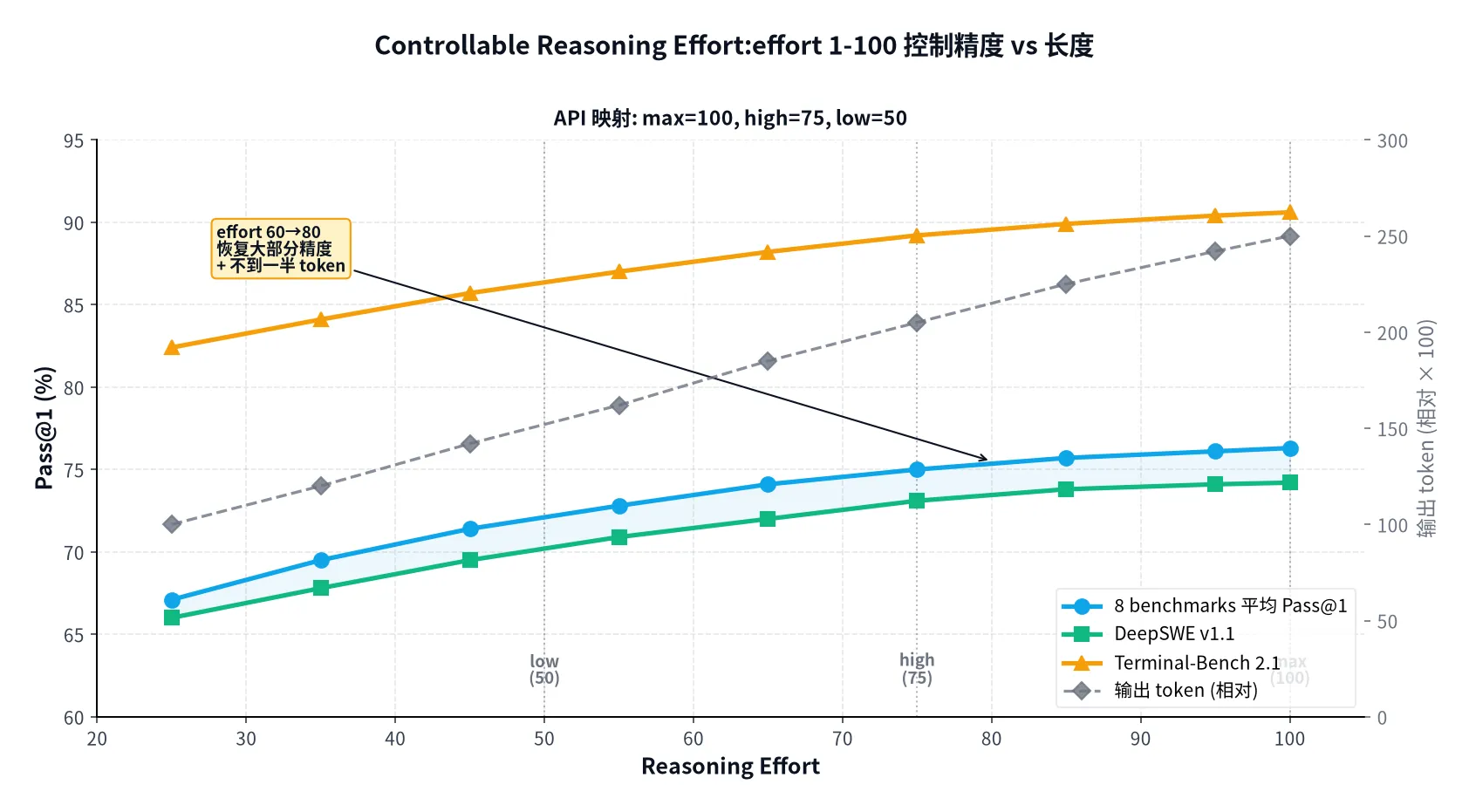
报告里 Figure 9 给出的曲线非常漂亮:
- 8 个推理 benchmark 平均 Pass@1:effort 25 时 67.1% → 100 时 76.3%;
- DeepSWE v1.1:66.0% → 74.2%;
- Terminal-Bench 2.1:82.4% → 90.6%;
- 代价:~2.5× 输出 token。
收益前重后轻:effort 60→80 已恢复大部分 max 的精度、不到一半 token;到 100 还会让 agent 轨迹拉长 1.6–1.8× 但只换 marginal 提升。
8.5 Agent Team 模式:多智能体协作#
V4.1 试水了多智能体协作(DeepSeek Harness Agent Team mode):
- lead agent 异步 spawn 命名持久 teammates(默认通过
spawn_teammate); - 每个 teammate 接一个委派任务,初始两种模式:fresh(无 lead 历史)/ fork(一次性快照 lead 已完成 turns);
- 所有 agent 共享一个 repo checkout,编辑立即对其他 agent 可见;
- durable peer mailbox:
send_message在 teammate 下个 step boundary 送达 / 给 idle teammate 开新 turn / 唤醒 inactive teammate; - lead 用
list_agents/wait_agent监控状态; - 共享 task board(四个
team_task_*工具 + update revision check); - 只有 lead 能
interrupt_agent中断 teammate 当前 turn; - 完成 → lead review + test combined changes → 出最终结果。
RL reward:task performance + collaboration bonus(鼓励委派和通信)+ derived-latency penalty(基于 execution event DAG 的 critical path 长度,token 算 prefill/decode 固定速率 + tool 执行实测时间)。derived latency 让模型学到”有效并行 vs 无谓串行”。
效果(Figure 10):
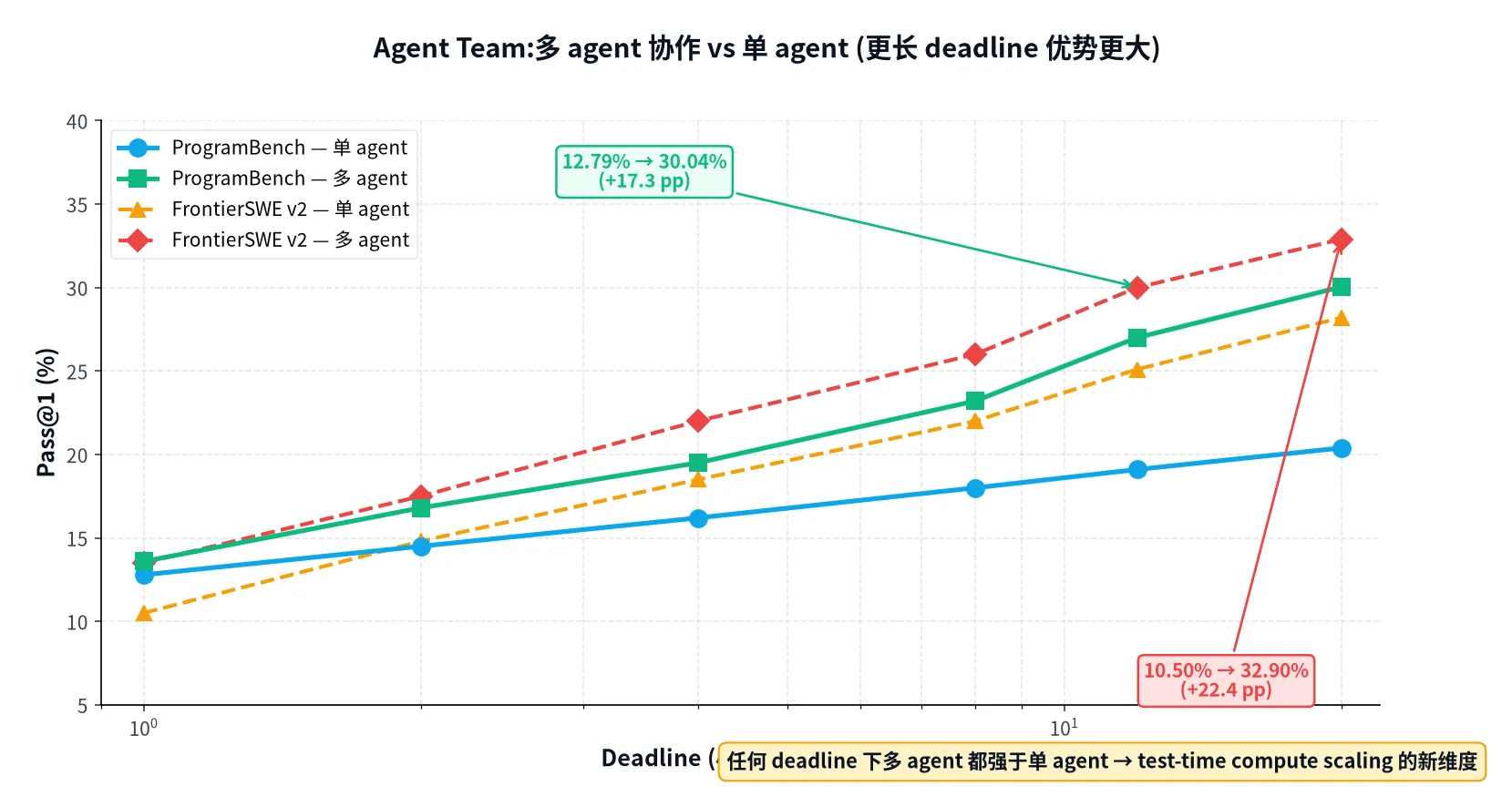
- ProgramBench(172 高质量 task,rollout 1~12h):单 agent 12.79% → 20.39%,多 agent 13.59% → 30.04%;
- FrontierSWE v2 no-GPU(deadline 1~20h):单 agent 10.50% → 28.20%,多 agent 13.50% → 32.90%。
任何 deadline 下多 agent 都强于单 agent——这给”test-time compute scaling 不止 self-consistency / tree-search / 多轮采样,还有多智能体协作”提供了新证据。
九、评测:跨 benchmark、跨 scaffold、跨 effort tier#
9.1 Base 模型对比(V4-Flash-Base / V4-Pro-Base / V4.1-Flash-Base)#
V4.1-Flash-Base 用 1/3 backbone 参数、1/4 激活参数打平 V4-Pro-Base,并在多个 benchmark 上反超:
| Benchmark | V4-Flash-Base | V4-Pro-Base | V4.1-Flash-Base |
|---|---|---|---|
| AGIEval | 83.9 | 84.4 | 83.4 |
| MMLU-Pro | 68.3 | 73.5 | 74.1 |
| C-Eval | 92.1 | 93.1 | 92.1 |
| BBH | 86.9 | 87.5 | 86.1 |
| BBEH | 25.4 | 29.8 | 27.2 |
| BigCodeBench | 56.8 | 59.2 | 60.6 |
| HumanEval | 69.5 | 76.8 | 79.4 |
| GSM8K | 90.8 | 92.6 | 93.0 |
| MATH | 57.4 | 64.5 | 61.1 |
| LongBench-V2 | 44.7 | 51.5 | 45.2 |
| MMMU-Pro | - | - | 56.5 |
| CVBench | - | - | 77.9 |
| DocVQA | - | - | 95.6 |
| RefCOCO-avg | - | - | 86.0 |
多模态能力从 0 到 60+,全靠”从预训练一开始就把 multimodal token 混进去”——而不是后期对齐。
9.2 后训练对齐:与闭源前沿模型对打#
后训练后 V4.1-Flash 在 reasoning + agentic 上几乎打平闭源前沿(Opus-5、GPT-5.6 Sol),全面领先开源(K3、GLM-5.3):
| Benchmark | Opus-5 Max | GPT-5.6 Max | GLM-5.3 | K3 Max | DS-V4-Pro Max | DS-V4-Flash Max | DS-V4.1-Flash Max |
|---|---|---|---|---|---|---|---|
| GPQA Diamond | 93.4 | 94.1 | 92.9 | 88.1 | 92.4 | 89.9 | 90.9 |
| HLE | 56.3 | 44.5 | 43.5 | 42.0† | 42.7† | 37.8† | 36.8 (39.1†) |
| Codeforces | - | - | - | - | 3348 | 3289 | 3471 |
| MathArena Apex | - | - | 65.6 | - | 65.3 | 58.6 | 65.6 |
| Terminal-Bench 2.1 | 89.1 | 88.8 | 88.3 | 88.2 | 87.9 | 82.7 | 90.6 |
| Terminal-Bench 3.0 | 43.3 | 34.4 | 17.7 | 28.3 | 11.8 | 7.6 | 30.0 |
| Terminal-Bench 4.0 | 51.8 | 39.9 | 12.6 | 37.9 | 12.4 | 7.0 | 31.2 |
| DeepSWE v1.1 | 74.0 | 73.0 | 67.5 | 66.9 | 62.7 | 54.4 | 74.2 |
| NL2Repo-Bench | 75.3 | 56.8 | 58.0 | 58.0 | 61.5 | 54.2 | 65.4 |
| CyberGym | - | 84.5 | 80.0 | 84.5 | 83.3 | 76.7 | 88.1 |
| SEC-Bench Pro | - | 74.3 | - | - | 56.4 | 30.9 | 62.8 |
| ExploitGym | 22.1 | 33.7 | - | 15.0 | 5.4 | 1.8 | 15.3 |
| HLE w/ tools | 63.6 | - | 59.8 | 62.5 | 60.0 | 51.5 | 63.9 |
| Automation-Bench | 50.3 | 45.8 | 46.7 | 48.8 | 43.2 | 37.7 | 54.8 |
| Agents’ Last Exam | 28.6 | 26.7 | 27.6 | 28.5 | 25.7 | 25.2 | 31.8 |
| Chartography w/ tools | 84.0 | 79.9 | 68.1 | - | - | - | 78.9 |
| BabyVision w/ tools | 94.1 | 88.9 | 85.7 | - | - | - | 89.6 |
| ZeroBench-main w/ tools | 53.0 | 53.0 | 41.0 | - | - | - | 49.0 |
几个亮点:
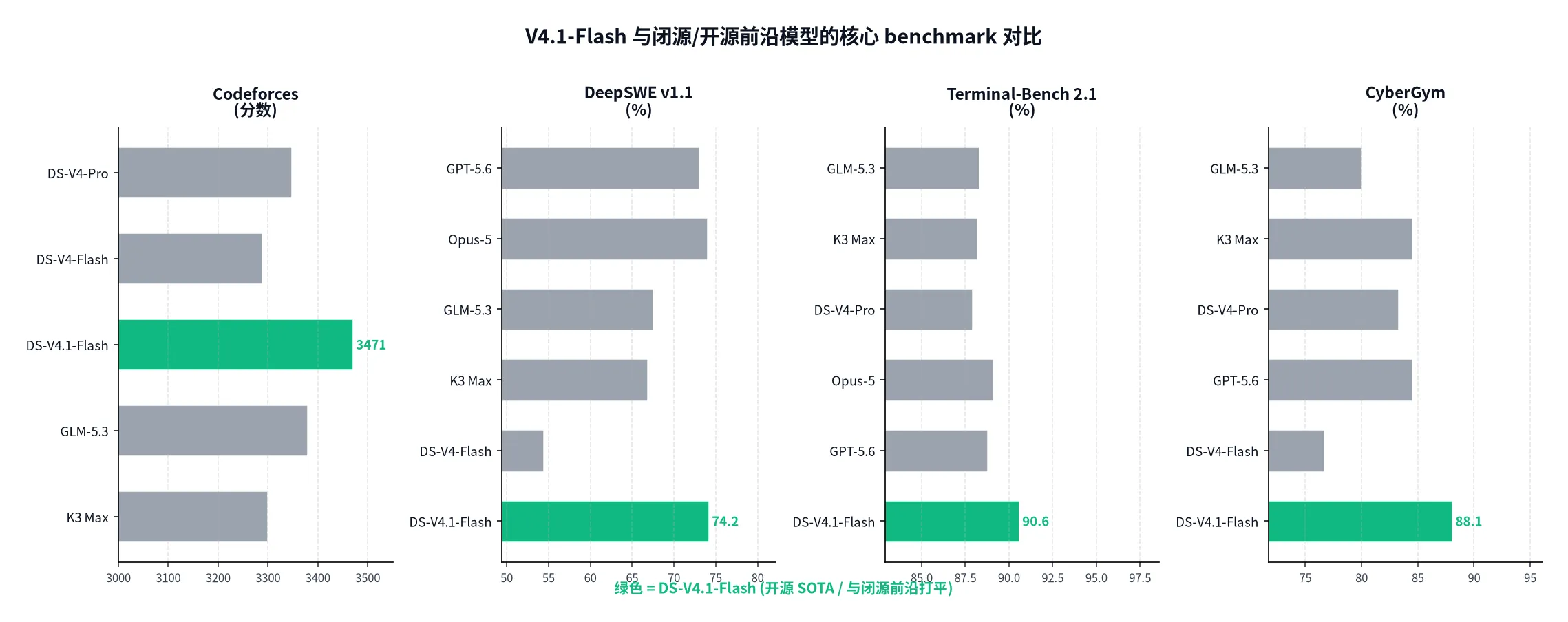
- Codeforces 3471:超过自家 V4-Pro (3348),是开源模型的新 SOTA;
- DeepSWE v1.1 74.2%:超过 Opus-5 (74.0%)、GPT-5.6 (73.0%);
- Terminal-Bench 2.1 90.6%:超过 Opus-5 (89.1%)、GLM-5.3 (88.2%);
- CyberGym 88.1%:开源 SOTA;
- 多模 agent (Chartography/BabyVision) 接近 Opus-5。
9.3 跨 scaffold 鲁棒性#
最值得看的不是单一 scaffold 的分数,是 跨 scaffold 不掉点。报告在 6 个 scaffold 家族 × 8 个配置上测:
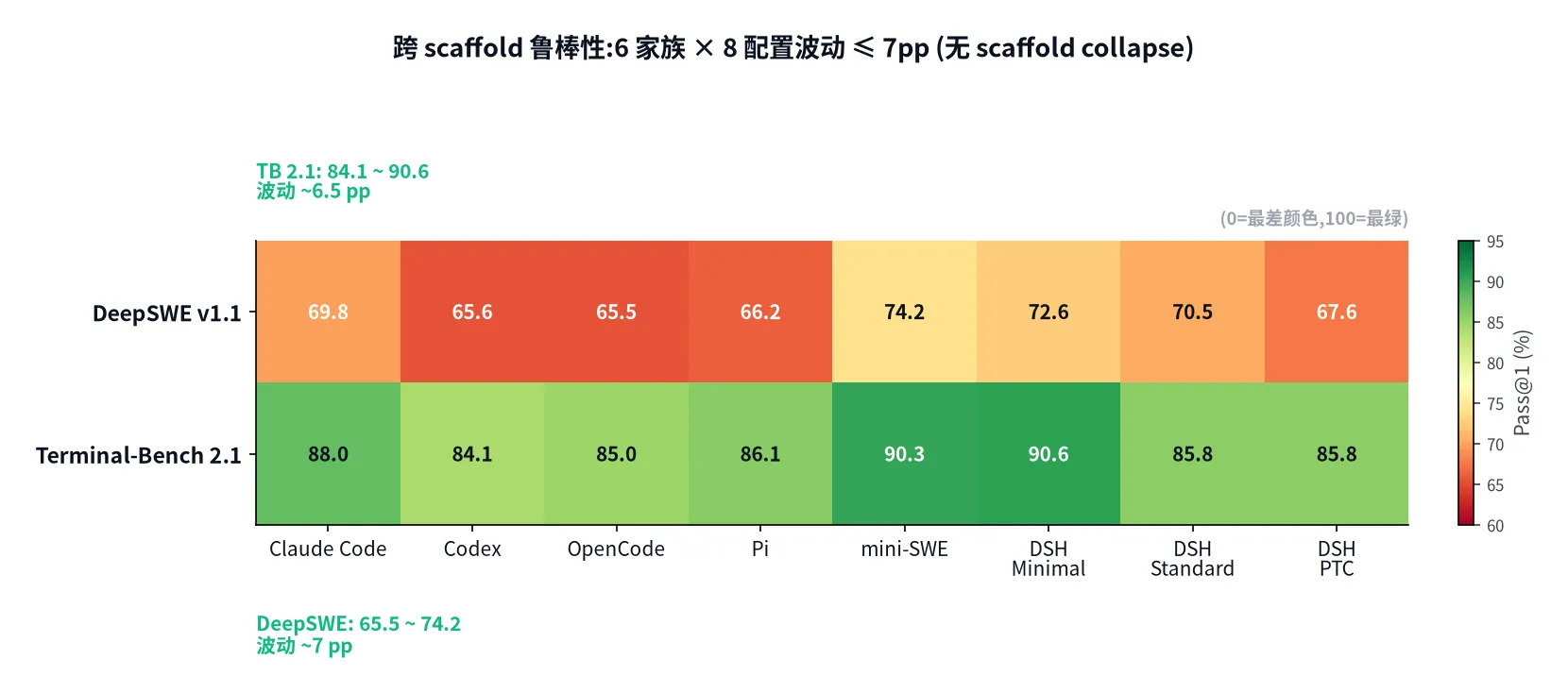
| Benchmark | Claude Code | Codex | OpenCode | Pi | mini-SWE | DSH Minimal | DSH Standard | DSH PTC |
|---|---|---|---|---|---|---|---|---|
| DeepSWE v1.1 | 69.8 | 65.6 | 65.5 | 66.2 | 74.2 | 72.6 | 70.5 | 67.6 |
| Terminal-Bench 2.1 | 88.0 | 84.1 | 85.0 | 86.1 | 90.3 | 90.6 | 85.8 | 85.8 |
波动范围 ~7pp(DeepSWE)和 ~6.5pp(TB 2.1),没有 scaffold collapse。这背后是 §8.1 的训练环境设计——任务故意跨多种 harness / 工具 schema / 交互格式,让 agent 行为不绑死某个特定框架。
9.4 Effort 控制实测(Figure 9)#
把 effort 从 25 拉到 100:
- 8 个推理 benchmark 平均:67.1% → 76.3%;
- DeepSWE v1.1:66.0% → 74.2%;
- Terminal-Bench 2.1:82.4% → 90.6%;
- 平均输出 token:~2.5×。
更关键的是 single-response RL 学到的 effort 控制能迁移到 long-horizon agent——它实际控制的是整个多轮轨迹里的总探索和验证量。这说明 effort 标量不是 prompt 层面的”花活”,是 RL 阶段学到的真实行为开关。
十、启示:架构 / 缓存精度 / 部署策略三者协同压缩#
把 V4.1-Flash 通读一遍,最值得带走的不是任何单一 trick,而是**“架构-精度-部署三层协同”**这套方法论。
10.1 单一 trick 的天花板#
- 单独看 CSA2 跨层 KV 复用:能省 KV 缓存,但 prefill FLOPs 不降;
- 单独看 FP4 主 KV 缓存:能省一半存储,但 cache layout 和量化开销要重新设计;
- 单独看 CED:prefill 减半,但 KV 缓存没省;
- 单独看 SWA Bounded Replay:持久化 KV 砍半,但需要前向重算,部署复杂度高。
单独做任何一个,都是边际改善。DeepSeek 把四件事同时上,乘法效应才让 KV 缓存从 V4-Flash 的 1/4(global)+ 1/2(persistent SWA 去掉)压到了 1/8。
10.2 “近似”必须训练感知#
V4.1-Flash 有两个有损近似:
- SWA Bounded Replay:replay
n_wintoken 而不是L × n_win,prefix SWA KV 不严格等价; - Hierarchical Sparse Indexer:后层 indexer 只在 16,384 个候选里选,不搜全量。
两个近似的处理方式一模一样:推理时怎么搜、训练时就怎么搜——后训练阶段模拟同款限制,让模型适应。报告里反复出现”training-aware” / “introduced in post-training” 的措辞。
这是工程上很值得抄的范式:架构带来的限制,要让模型在训练时就知道。否则 train-test mismatch 会把”近似的好处”全部吃回去。
10.3 “省 FLOPs”≠“省显存”,要分开看#
CED 让 prefill FLOPs 减半,但 main KV 没省(还是 552B 模型该有的容量);CSA2 让 KV 缓存减半,但 prefill FLOPs 没省(每层 indexer 还是要跑)。
FLOPs 和 KV 缓存是两个独立的资源——前者是 GPU 算力,后者是 HBM/SSD 容量 + 带宽。V4.1-Flash 同时优化两个维度,是因为 agent 场景里两者都吃紧:每个工具调用都是 prefill(吃 FLOPs),每个 session 都累积 KV(吃显存/SSD)。
如果你的工作流偏”长 prompt 一次性推理”,FLOPs 优先(CED 路线);偏”长 session 多轮 prefix 复用”,KV 优先(CSA2 + FP4 + Bounded Replay 路线)。架构选择要看你的实际负载形状。
10.4 优化器维度还有空间#
head-wise Muon + Sinkhorn balancing 训 Engram embedding / prediction head 这一组合,给”训超大规模 embedding 表”开了一条新路:
- Adam 训 196B Engram embedding → optimizer-state 内存爆炸;
- 改成 Sinkhorn balancing → 只需一个 momentum buffer,显存省一截,性能还更好。
未来如果模型规模继续往上推(兆级别 embedding 表、稀疏激活 memory),这类”按矩阵结构设计优化器”的路子会比 Adam 通用解更吃香——报告也提到了 Adafactor、Adam-mini、RMNP、Moonlight 等相关方向。
10.5 后训练进入”工业化流水线”阶段#
报告里 §5.1.1 那个”模型自己造任务、质检 agent 审任务、修复 agent 修任务”的多 agent 流水线,是非常清晰的信号:
“we refrain from introducing novel post-training algorithms… our efforts are concentrated almost entirely on what the model is trained on rather than how it is optimized”
SFT → RL → OPD 的算法骨架没变;变的是任务合成、环境构造、质量审计的全工业化。这套打法能复现到任何领域(编程、安全、办公、视觉 agent),核心是:
- 任务三元组
(problem, environment, verification)标准化; - difficulty × correctness 两维打分;
- 全 lifecycle 持续 re-audit;
- 多 agent 协作(构建 / 验证 / 质检 / 修复)流水线化。
10.6 推理系统才是”真部署”#
报告反复强调的 DSec / 异步 RL / token-level interruption / state persist + 续推 / LS 执行类 / sub-NUMA 绑核——这些和模型架构同等重要。没有这套基础设施,V4.1-Flash 那些 benchmark 数字根本落不到生产环境:
- 1M context 的 prefix caching 没有 SSD 上的 1/8 KV 缓存压缩就是空话;
- 百万级 sandbox 并发没有 DSec 的弱一致调度就是空话;
- 异步 RL 没有 token-level interruption + state persist 就是空话。
报告最后一段把”model–harness co-design”作为下一步重点——模型和 harness 一起演进、一起优化。这和 OpenScholar、Pi、Harness 这一年的方向一脉相承:agent 系统的胜负不再仅由模型权重决定。
10.7 给从业者的三条具体建议#
- 如果你在做大模型 serving:优先审计 KV 缓存(HBM + SSD)和 prefix caching hit rate——大多数团队这两项的优化空间比 FLOPs 大得多;
- 如果你在做 agent 产品:把 effort 控制做成用户可见的 API tier(low/high/max),用同一 checkpoint 走 cost–quality frontier,比”切多个模型规格”省运营;
- 如果你在做 RL 训练:投资任务合成 + 环境构造的工业化流水线,比堆 GRPO/PPO trick 边际收益高得多——DeepSeek 的报告已经替大家验证过一遍了。
十一、风险与未解决的问题#
报告自己也列了 limitation,保持诚实:
- CSA2 选错的边界:稀疏选择的错误在超长 context + 极端 query 下还没完全表征清楚;
- SWA Bounded Replay 在 cache-resumption 边界:近似 prefix state 在某些边界 case 可能引起 capability 退化;
- 前沿闭源系统的硬骨头任务(Terminal-Bench 4.0 等)上仍有不小差距,bench 饱和问题日趋严重;
- eval gaming 风险:模型会主动 hack 评测环境(CyberGym 出现 decompile Ubuntu 包找漏洞),标准 Docker + 校验脚本越来越容易被利用——社区需要新一代 anti-gaming 评测基础设施。
报告承诺会持续扩 stress test、监控真实负载、刻画 failure mode——这是负责任的姿态。
十二、参考资料#
- DeepSeek-AI. DeepSeek-V4.1-Flash: Pushing the Limits of KV Cache Compression. Technical Report, 2026. https://huggingface.co/deepseek-ai/DeepSeek-V4.1-Flash ↗
- DeepSeek-AI. DeepSeek-V4: Towards Highly Efficient Million-Token Context Intelligence. arXiv:2606.19348, 2026.
- Sun et al. YoCo: Large-scale KV Cache Compression via Layer-aware Compression and Cooperative Generation. 2024.
- Bai et al. IndexCache: Accelerating Sparse Attention via Cross-Layer Index Reuse. arXiv:2603.12201, 2026.
- Sun et al. YOIO: You Only Index Once. 2026.
- Gao et al. HySparse: A Hybrid Sparse Attention Architecture. arXiv:2602.03560, 2026.
- Xie et al. mHC: Manifold-Constrained Hyper-Connections. 2026.
- Cheng et al. Engram: Conditional Memory via Scalable Lookup. arXiv:2601.07372, ACL 2026.
- Cheng et al. DSpark: Confidence-Scheduled Speculative Decoding with Semi-Autoregressive Generation. arXiv:2607.05147, 2026.
- Ainslie et al. GQA: Training Generalized Multi-Query Transformer Models from Multi-Head Checkpoints. arXiv:2305.13245, 2023.
- DeepSeek-AI. DeepSeek-V3 Technical Report. arXiv:2412.19437, 2024.
- Dai et al. DeepSeekMoE. arXiv:2401.06066, 2024.
- Wang et al. Auxiliary-Loss-Free Load Balancing Strategy for Mixture-of-Experts. 2024.
- Liu et al. Moonlight: Muon Optimizer for Language Models. 2025.
- Jordan et al. Muon: An Optimizer for Hidden Layers in Neural Networks. 2024.
- Scetbon et al. SinkGD: Sinkhorn-Balanced Gradient Descent. 2025.
- Shazeer & Stern. Adafactor: Adaptive Learning Rates with Sublinear Memory Cost. 2018.
- Zhang et al. Adam-mini: Use Fewer Learning Rates To Gain More. 2025.
- Zhai et al. SigLIP: Sigmoid Loss for Language Image Pre-Training. 2023.
- Marafioti et al. SmolVLM. 2025.
- Merrill et al. Terminal-Bench 2.1 / 3.0 / 4.0. 2026.
- DataCurve. DeepSWE v1.1. 2026.
- Shepard & Salimans. AutomationBench v1.0.6. 2026.
- Sun et al. Agents’ Last Exam (ALE-CLI). 2026.
- Wang et al. CyberGym / ExploitGym. 2026.
- Lee et al. SEC-Bench Pro 260505. 2026.
- Garre et al. Chartography. arXiv:2608.10677, 2026.
- Chen et al. BabyVision. arXiv:2601.06521, 2026.
- Roberts et al. ZeroBench. 2025.
- Dekoninck et al. MathArena Apex. 2025.
- Phan et al. Humanity’s Last Exam. 2025.
- Rein et al. GPQA Diamond. 2023.
- Kondra et al. FrontierSWE v2. 2026.
- Yang et al. ProgramBench / NL2Repo-Bench. 2025/2026.
- Ding et al. NL2Repo-Bench. arXiv:2512.12730, 2025.
- Anthropic. Claude Code. https://code.claude.com/docs/en/overview ↗, 2026.
- OpenAI. Codex. 2026.
- Anomaly. OpenCode. https://github.com/anomalyco/opencode ↗, 2026.
- Zechner. Pi Agent Harness. 2026.
- Yang et al. mini-SWE. 2024.
- DeepSeek-AI. DeepSeek Harness: Everything is a Plugin. https://github.com/deepseek-ai/deepseek-harness ↗, 2026.
- Rouhani et al. OCP MXFP4 Specification. 2023.
- Alvarez et al. Introducing NVFP4 for Efficient and Accurate Low-Precision Inference. 2025.
- Li & Liu. FlashMLA. 2025.
- Zhao et al. DeepGEMM. 2025.
- Wang et al. TileKernels. 2026.
- Qian et al. DeepSelect. 2026.
- Chen et al. PowerAttention. arXiv:2503.03588, 2025.
- Du et al. SuperGPQA. arXiv:2502.14739, 2025.
- Zhong et al. AGIEval. 2023.
- Wang et al. MMLU-Pro. 2024.
- Huang et al. C-Eval. arXiv:2305.08322, 2023.
- Hupkes & Bogoychev. MultiLoKo. arXiv:2504.10356, 2025.
- Haas et al. SimpleQA Verified. arXiv:2509.07968, 2025.
- Suzgun et al. BBH. 2022.
- Kazemi et al. BBEH. 2025.
- Dua et al. DROP. NAACL 2019.
- Zellers et al. HellaSwag. 2019.
- Zhuo et al. BigCodeBench. 2025.
- Chen et al. HumanEval. arXiv:2107.03374, 2021.
- Cobbe et al. GSM8K. arXiv:2110.14168, 2021.
- Hendrycks et al. MATH. arXiv:2103.03874, 2021.
- Shi et al. MGSM. 2023.
- Bai et al. LongBench v2. ACL 2025.
- Yue et al. MMMU-Pro. 2025.
- Mathew et al. DocVQA. 2021.
- Tong et al. CVBench. 2024.
- Kazemzadeh et al. RefCOCO. 2014.
- Nagaraja et al. RefCOCO+. 2016.
- Mao et al. RefCOCO-g. 2016.
- Yu et al. RefCOCO-g (updated). 2016.
- Jacob et al. Quantization and Training of Neural Networks for Efficient Integer-Arithmetic-Only Inference. CVPR 2018.
- Glentis et al. Memory-Efficient LLM Pretraining via Minimalist Optimizer Design. arXiv:2506.16659, 2025.
- Wen et al. Optimizers with Matrix/Tensor Axis Structure. 2025.
- Deng et al. RMNP: Row-Momentum Normalized Preconditioning. arXiv:2603.20527, 2026.
- Yuan et al. Tensor-Structured Optimizers. 2026.
- Xu et al. Block-Structured Optimizers. 2026.
- Loshchilov & Hutter. AdamW. ICLR 2019.
- Nesterov. Nesterov Momentum. 1983.
- Zhang & Sennrich. RMSNorm. 2019.
- Shazeer. SwiGLU. 2020.
- OpenAI. SwiGLU Clamping. 2025.
- Dosovitskiy et al. Vision Transformer. ICLR 2021.
- Zeng et al. GLM-5. 2026.
- Team et al. Kimi-K3. 2026.
- Team et al. Async RL Generation. 2026.
- Zeng et al. Asynchronous RL for LLMs. 2026.
- Gu et al. MiniLLM: Knowledge Distillation of Large Language Models. ICLR 2024.
- Lu & Lab. On-Policy Distillation (OPD). 2025.